‘There is no such thing as snake repellent’: Volunteer snake catcher shares insight into peak season dangers
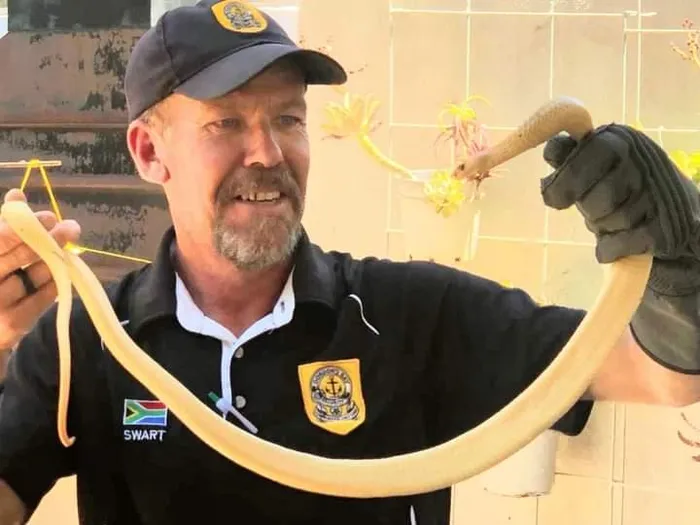
Snake catcher Blackie Swart holding a Cape cobra he caught in Gordon's Bay last year.
Image: Supplied
With summer heat driving up snake call-outs across the Helderberg, Somerset West volunteer snake catcher Blackie Swart finds himself facing one of the most demanding seasons of his career.
He has been working as a snake catcher for the past fifteen years, having previously worked as a police reservist for 28 years.
He remembers when frightened residents would turn to the police or fire brigade to remove snakes from their homes. In an interview with Bolander, he reflected on how those moments shaped his path into snake catching and his continued efforts to educate communities about coexisting safely with snakes.
One particular incident in 2008 left a lasting impression on him in Delft, when he was still a police reservist.
“We attended a call where the snake had already been killed, and while we were still there, children started playing with it. People don’t realise that a dead snake is still venomous. A young boy cut his finger on the fang and had to be rushed for medical help. That was a rude awakening,” said Mr Swart.
That incident proved to be a turning point, leading him to learn as much as he could about snakes and to start educating others.
However, the snake season generally runs from September to around April.
Since the beginning of the season last year, he has caught and released 163 snakes, with around 85% classified as highly venomous species. Between early December and January 5 this year alone, he was called out to relocate 27 snakes.
“There is no such thing as snake repellent. Keep your properties clean, grass short, and remove rubble. Snakes rely on three things: food, water and shelter. They are very important to our ecosystem, as they control rodents. If there were no snakes, we would be overflowing with mice and rats all around us."
Mr Swart added that he had previously removed a snake from a property where the owner was using a product believed to keep snakes away.
He admits the work can be emotionally difficult, especially following the death of fellow snake catcher and close friend Rico Pentz, who died from a snake bite two years ago.
"That was traumatic because he was a friend of mine. But accidents do happen. When you tell me to go into a garden and look for a snake, but you saw it there the last time. I don't know where the snake is.
"That snake knows I'm there. It picks up my vibration as I'm looking for it. And I might just put my foot in the wrong place, and I get bitten. So yes, it's a very risky job. But it's a passion that we as snake catchers have."
All snakes Mr Swart captures are assessed for health, fed if necessary, and released far from residential areas.
For residents like Nikki Pretorius, whose parents live in Gordon’s Bay, his work has brought both relief and reassurance. Ms Pretorius recalled an incident last year when a snake had settled near the pump of a water feature, hidden beneath astroturf.
“We called Blackie immediately and kept an eye on the area until he arrived, which was impressively quick. He safely removed the snake and took time to educate us, and our neighbours. He allowed them to touch the snake under supervision, turning it into a learning moment rather than a scary one,” she said.
Zoologist and reptile expert Francois van Zyl said snakes do not hunt people. Instead, most snakebite incidents occur when a snake is accidentally stepped on, cornered, handled incorrectly, or when people attempt to kill it.
"Snakes have always been part of the Western Cape’s natural landscape. What has changed in recent decades is not the presence of snakes, but the extent to which human development now overlaps with their habitat.
"This has resulted in more snake sightings, not because snake numbers are increasing dramatically, but because people and snakes are now sharing space more closely," he said.
Professor Savel Daniels, from the Department of Botany and Zoology at Stellenbosch University, said the Cape cobra, boomslang, and the puff adder are the three main venomous species found in the Western Cape.
For more information, contact Mr Swart on 083 659 8329 or via his Facebook page, Blackie Swart Snake Relocations 24/7.
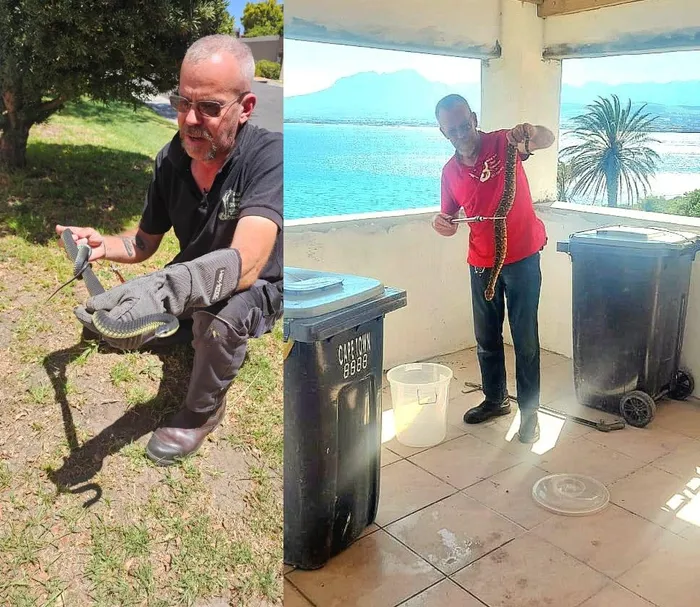
With summer heat driving up snake call-outs across the Helderberg, Somerset West volunteer snake catcher Blackie Swart finds himself facing one of the most demanding seasons of his career.
Image: Supplied